Showing posts with label Annapurna. Show all posts

Tuesday, January 6, 2015

Annapurna Circuit - part 2

Although the trail led to Manang (3540m) I decided to finish the day in the quieter and picturesque village of Bragha / Bhraka (3470m).
 
What to do around Bragha...

On the way to Buddhist Monastery above Munchi
On the way to the Ice Lake

The alpine biome found between the river bed where Bragha (3540m) is found and up to the Ice Lake (4600m) is a tough place for plants to live. It’s windy, cold, and the sunlight at these high altitudes is very strong. Because of the harsh weather, most plants are small groundcover plants, which grow and reproduce slowly. When plants die the cold weather
makes it hard for them to decompose quickly reducing available nutrients for new growing plants...
 

Anyhow, my observation is that trampling and overgrazing by the numerous yaks and wood fuel used by shepherds is leaving a permanent footprint. Hopefully, the demand for yak jerky and cheese will not increase unreasonably in the near future, and as a result further deteriorating this fragile environment...
 

What is left of the vegetation on the way to the Ice Lake


Yakidiyak


Awakening of Manang


Difficult to get lost!

With the Pisang Peak Base Camp (4000m) and the Ice Lake (4600m) under my belt I felt acclimatized enough to set for Thorung La pass (5416m). From Bragha I hiked to the Thorung High Camp for the night. Another great day with very little traffic but nonetheless some interesting action.
 

Below the High Camp was a steep and slippery section of old frozen snow. Two porters ahead of me were desperately trying to haul a mountain bike wearing city shoes. For a few
seconds, the image of two young boys holding an expensive bike, and flying by me crossed my mind. This would certainly be the deadliest tobogganing of their life! I rapidly made my
way through the knee deep soft snow and grabbed the first boy by the wrist. I hauled both of them all the way to the High Camp.
 

I am aware that hiring porters and/or guides without intermediate might sound more profitable for both parties but I do wounder who ends up paying for the injured when incapable of working and/or the family when death occurs?

The following day was quite chaotic. It felt like climbing the Mont Blanc on the busiest European holiday! At least the suffering (waiting behind the endless queues) was not to long, and soon enough, I was enjoying the sun over the pass.
 

The proof that I made it!
 From Thorung La pass 1600m of steep descent to Muktinath (3800m) awaits every single trekker. The views are absolutely incredible!


Muktinath is both a dusty, far-west-like village, and an important pilgrimage site for Buddhists and Hindus alike. They come from all over India using the Naya Pul to Jomsom road or by flying to the Jomsom airport.
 

One bell per wish


View from Jhong village – on the way to Kagbeni (2840m)

From Kagbeni one can head towards the Mustang area or south towards Jomsom. The airport and road portion of Jomsom is also a major trail junction for routes to the Dhaulagiri and Dolpo regions. Let's be honest, Jomsom is not nice but hikers can find everything they need here.
 

Looking at the Mustang entry from Kagbeni

Towards Jomsom and Naya Pul

If time and energy remain, the trek from Jomsom to Naya Pul via the new trail settled up by ACAP (to avoid the road) is simply spectacular. Every single village has is own charm. The western-like environment transforms itself into luxurious and diverse vegetation, temperature rises and food prices drop.


Trekkers reaching Tatopani can take the time to recover while soaking in the nice Hot Springs. Further south, the Poon Hill sunset is also a must do. Simply set your alarm clock one hour before sunset and follow the crowds. 


The journey only finishes when back in Pockara after embarking a public bus in Naya Pul. Few hours later one can enjoy a nice diner at the Lake side Pokhara...

THE END ;)

Annapurna Circuit - part 1


I have been pretty much motionless since early 2013 after spending 2 months in the hospital and later on, damaging my knee LCL. Good news is, the Conservation Project I was involved with happen to be a good continuity in order to regain my mobility. Living and hiking above 2000m on a daily-base throughout the project was definitively beneficial for my legs and mind to regain some strength. Therefore, I could envision exploring or, at least, get a taste of those appealing mountains surrounding Ghandruk.

I set the achievable goal of completing the Annapurna Circuit trek, and therefore get a better look at those beautiful mountains. This trek is accessible to all as it doesn't require any technical skills and trekkers can find food and/or lodging on trek every hour or two. This circuit remains affordable compare to other treks; only the Annapurna Conservation Area (ACA) Single Entry and Trekkers Information Management System (TIMS) permits (2 x 20 USD) are required for this trek. I managed to pay 100 NRP / night for a room with attached toilet and shower although for food it is another story as prices increase proportionally with altitude.

Annapurna Circuit Map

This is definitely a must do!

From Pokhara one can already enjoy the sight of Annapurna I (8091m) and Machhapuchhare (Fish Tail Peak, 6997m). Although to the north of the massive bulk of the Annapurna is a valley system that leads to Tibet through the villages of Naar and Phu as well as the Mustang region. Unfortunately, the Tourism Bureau would not provide me with a permit for these two areas without a group and guide... 

Tal to Tilicho Lake Map

These two trekking areas have been added to my to do list.
 
I highly suggest to take the local bus to immerse oneself into local's folklore (leaving any security consideration behind). Public bus in Nepal are cheaper than food and pretty entertaining. So after my share of cultural immersion between Pokhara and Besisahar, I started my trek from Ngadi (about 1h bus ride north from Besisahar) without much
expectations and with limited time.

After overcoming the choc of the impressive dam and adjacent road (by and for the Chinese) in the middle of this semi wilderness, I quickly fund myself hiking throughout luxurious vegetation, terraces and villages.

The trail follows the east bank of the Marsyangdi Khola (river) from this point.

Colorful & welcoming Chamche's Guesthouse
While engaging into this journey, one can indulge unique fauna and flora but also witness the day-to-day life-style of the communities occupying the region.

Little adorable friends in Ghermu


Passing by a school between Germu to Tal; 
these kids will do anything do get something out of you! :)

What I find the most interesting is the never ending variety of landscapes. From luxurious forest to arid tundra, through hanging bridges and well-maintained trails, by Hindu Temples
and Buddhist Stupas and prayer wheels....

One of the many suspension bridges...

I believe this one is color blind!

Shepherd at work ;)

Prayer wheels

While appreciating every moment of my journey, I could however capture some environmental threats and/or consequences of this Eco-touristic practice in the region. An important portion of the forest cover is no more due to, what looks like, forest fire and intense logging I believe for the construction of hotel/housing accommodations, and fuel wood for cooking and heating.


Making of wooden boards


Eco-friendly transportation of wooden boards – just kidding ;)

And again, the journey continues with more breathtaking views and surprising findings. In Bhratang trekkers can satisfy their sweet craving with apple pie or fresh apples as Gala and Red delicious where introduced about 50 yrs ago. I also learned from the owner that the current orchards were about to be replaced by a new variety from Holland in order to increase both apple size and productivity. 

Fascinating!
 

Cross-generational exchanges
 
Time to get up in Chame for another great hiking day!

Past Bhratang the trail climbs to Timang and then continues through a section of gorgeous pine and fir forest. Further up, Lower and Upper Pisang (3310 m) are found on both banks of the Marsyangdi Khola in a much more arid environment.


Lower & Upper Pisang from the Pisang Peak Base Camp (4000m)
 
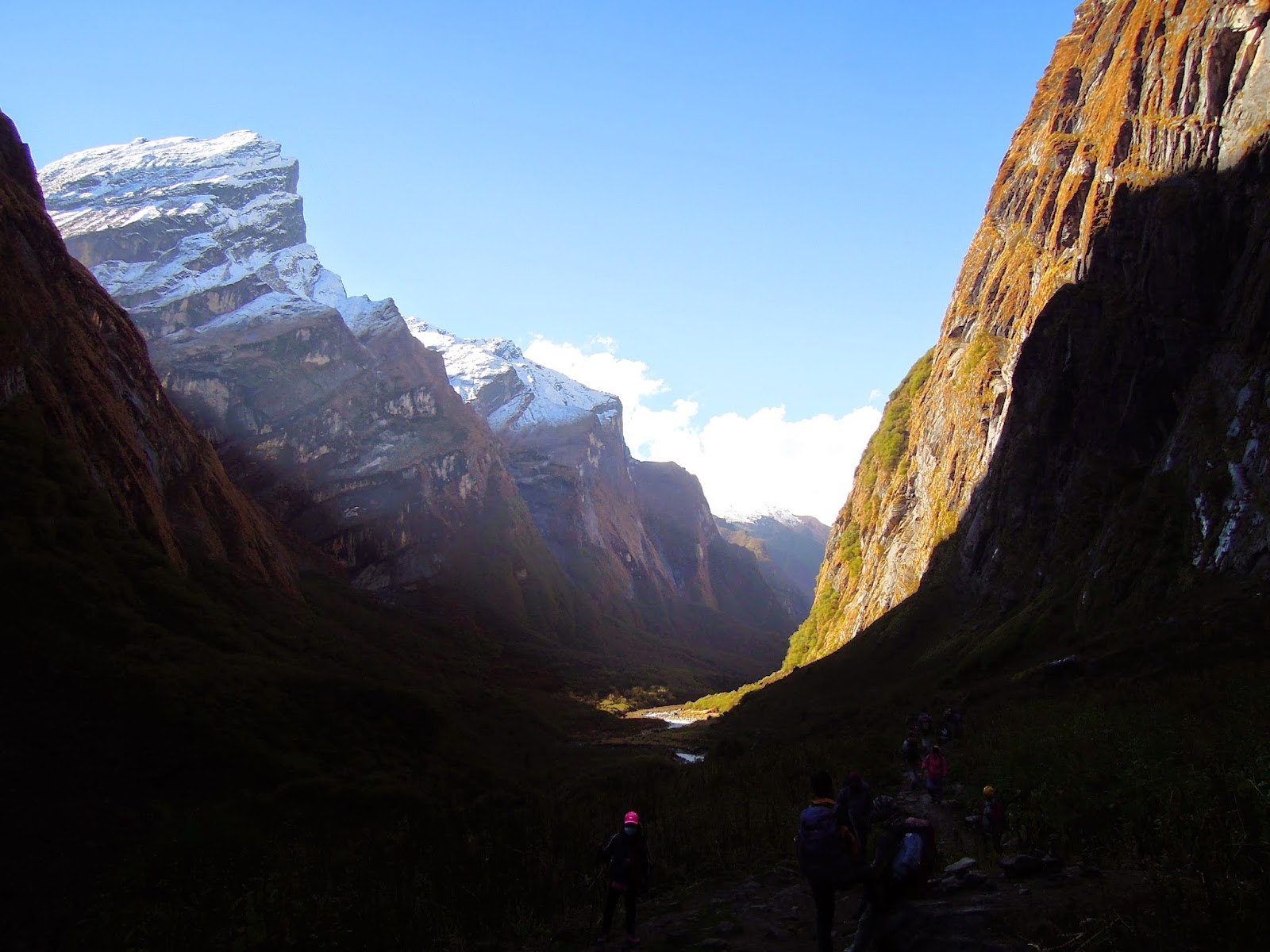
From Pisang it is definitely worth the effort of hiking what they call the high route (north of the Marsyangdi Khola). The mountain views on the on the upper trail via Ghyaru and Ngawal (3660m) are breathtaking and this effort also pays in terms of acclimatisation.
 
To provide kids with coloring crayons rather than sweets or money is, in my opinion, a good idea.
 
Prayer Wheels


Simply magical!


Sunday, November 16, 2014

Annapurna Sanctuary Trek

Don't miss the sign to the Annapurna Base Camp

So five motivated volunteers and myself decided to head to the Annapurna Base Camp (ABC: 4130 m) for a bit of exploration. We left Ghandruk Thursday (Oct. 23) after breakfast with the objective to reach the ABC and return by Sunday.

Five motivated volunteers, myself & the sunrise over the ABC

It took us 4h to reach Chhomrong (2170 m) from our Ghandruk Guest House (2100 m). After traversing the old Ghandruk, an endless stone staircase surrounded by rice and millet paddies took us first all the way down to the Kimrong Khola (river) where a suspension bridge allowed us to reach the opposite side.

Old Ghandruk

Suspension Bridge over the Kimrong Khola

Naturally, what goes down generally goes up again! We then climbed another staircase up to Kimrong (1800 m), Taulung (2180 m) and Chhomrong. After lunch, we made it to Bamboo (2310 m) in 3.5h. Once more, the trail drops down a set of stone steps to the Chhomrong Khola, and then climbs to Sinuwa and on through rhododendron forests although not in flowers at the time, to Kuldi (2470 m) and finally to Bamboo (2310 m) where we spent the night.

Beautiful scenery from Sinuwa looking at Ghandruk
 
Lucky we were to see some Hanuman Langur throughout the luxurious forest
Friday morning, we hiked from Bamboo (2310 m) to Deurali (3230 m) in 2 1/4h passing through Doban (2540 m) and Himalaya (2840 m).

Sure enough, no one ate meat....

Although there were no sight of snow, we passed several avalanche chutes on the way. After a quick bite, and another hour of hiking we reached the Machhapuchhare Base Camp (3700 m) just before the clouds. This mountain is sacred and therefore it is not permitted to climb it.


Machhapuchhare Base Camp 3700 m

We set the alarm clock for 4 am on the following day in order to witness the sunrise illuminating the magnificent amphitheatre of rock and ice surrounding the South Annapurna Base Camp (ABC 4130 m). It took us about an hour to reach the moraine past the ABC.

Temperatures were low and the sight of snow made feel at home for a moment ;)
 
Approaching ABC before sunrise

Sunrise on the Annapurna Base Camp

Once the day took over the sunrise, we headed back to our MBC Hotel ate breakfast and started our descent to Ghandruk. We took 3h to reach Bamboo and 1h to reach Chhomrong where we spent the night. Sunday morning we hiked the last 3 1/4h to Ghandruk early enough to be on time for our 11h lunch at our Guest House.

 
This (minus the crowds), I like!

Sunday, November 2, 2014

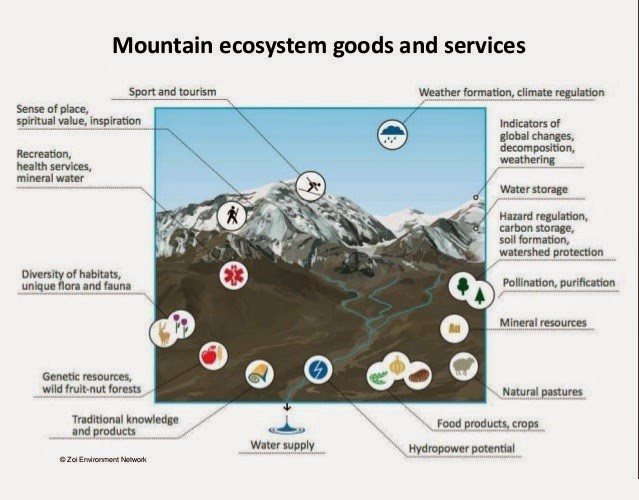
Mountain Ecosystem Goods and Services

When one talks about Goods and Services, everyone understand. Although, when I speak about Ecosystem Goods and Services, a big question mark generally appears in my interlocutor’s face.
 
In short, the term ecosystem refers to the combined physical and biological components of an environment. These organisms form complex sets of relationships and function as a unit as they interact with their physical environment (WHO).
 
Ecosystem Goods and Services are the benefits people obtain from ecosystems, often for free. These include provisioning services such as food and water; regulating services such as flood, weather and disease control; cultural services (non-material benefits) such as spiritual, recreational, and cultural benefits; and supporting services such as nutrient cycling that maintain the conditions for life on Earth. 

These Goods and Services are essential for human well-being and survival. Therefore, when we impact our ecosystems, we consequently impact our well-being.
 
The Millinium Assessment provides a Conceptual Framework of how human well being and health is impacted by changes in ecosystems, at local, regional, and global scales.


The demand for ecosystem services is now so great that trade-offs among services have become the rule. A country can increase food supply by converting a forest to agriculture, for example, but in so doing it decreases the supply of services that may be of equal or greater importance, such as clean water, timber, ecotourism destinations, or flood regulation and drought control.
 
The problem posed by the growing demand for ecosystem services is compounded by increasingly serious degradation in the capability of ecosystems to provide these service. This is particularly true when dealing with mountain environments.
 
http://www.slideshare.net/CIFOR/mapping-vulnerability-and-resilience-for-ecosystembased- approaches-to-adaptation


This is also why I was really interested in learning more about the Nursery Project as Ghandruk is located in a mountain region. Mountain regions are characterized by sensitive ecosystems, enhanced occurrences of extreme weather events, and natural catastrophes such as land slides and floodings or such as the recent avalanche at the Thorung La pass.

View from our guest house 2100 m overlooking from left to right at: Annapurna South 7219 m, Annapurna I 8091 m, hidden behind the mountains Annapurna Base Camp 4130 m, Mardi Himal 5587 m behind the clouds and      Machhapuchre (Fish Tail) 6993m.

This project addresses tree obvious objectives directly linked to the management of difficult environment such as mountain and alpine ecosystems. The first objective being to ensure timber for construction, fuel for cooking and forge plants for buffalo and oxen. Insuring the availability of such plants and schrubs helps reducing soil erosion due to a combination of intense grazing and important precipitations during monsoon’s seasons. Finally, the third objective aims at maintaining and improving the Biodiversity through the growing of rare and endangered species according to IUCN red list.

Sadly, the greenhouse build for the purpose of maintaining Biodiversity through critically endangered tree and schrub species planting was destroyed during last monsoon's season (July & August 2014).
 
Seasonal needs for goods and services are directly linked to tourism

Ever wondered how Tea Houses and Hotels can provide food at such altitudes as the 4130 m of the ABC

Often regarded as hostile and economically nonviable regions, mountains have attracted major economic investments for tourism. We can simply look at the Canadian Rockies or the French Alps to predict the issues places like the Annapurna Conservation Area might be facing in the near-future. The projected amplitude and rate of climatic change in coming decades is likely to lead to significant perturbations of natural systems as well as the social and economic structure of mountain societies, particularly where these are marginal. 

Because in many instances mountains and uplands are regions of conflicting interests between economic development and environmental conservation, shifts in climatic patterns probably will exacerbate the potential for conflict. Sadly, this story seems to repeat itself over and over again around the world.
 
The daily life of Ghandruk communities is closely linked to seasonal cycles both in terms of agriculture and tourism industry which in turn, is under the influence of weather's whims.
 
As a major ecosystem representing the complex and interrelated ecology of our planet, mountain environments are essential to the survival of the global ecosystem. 

Mountain ecosystems are, however, rapidly changing. They are susceptible to accelerated soil erosion,landslides and rapid loss of habitat and genetic diversity. On the human side, there is widespread poverty among mountain inhabitants and loss of indigenous knowledge. As a result, most global mountain areas are experiencing environmental degradation. Hence, the proper management of mountain resources and socio-economic development of the people
deserves immediate action.
 
I certainly hope that the Annapurna Conservation Area Project (ACAP) will continue to work closely with the communities to reduce the degradation of this beautiful place.


With the support of ACAP, solar panels and small hydroelectric plants provide Ghandruk with energy