Showing posts with label Ghandruk. Show all posts

Thursday, December 25, 2014

Nepal volunteering project – the end

Still processing everything I experienced and learned throughout my stay in Nepal and simultaneously, realizing how time flies!

First of all, I would like to thank all the fantastic people I had the chance to cross path and exchange with while in Nepal. I always felt safe even when travelling alone and always found help when in need. Directly related to the project, I need to outline the resourcefulness and good spirit of our Project Coordinator, Raj.
Our Project Coordinator, Raj


Raj seems to be involved with pretty much every single aspect of Ghandruk. It is obvious that he cares about not only the volunteers working on the conservation project but also about Ghandruk and its communities in general. Likewise, Raj's parents and our cook where absolutely great. Thanks to our cook, I was able to learn the Nepali valuable essentials allowing me to order food and buy the basic things I needed.

 
Raj's mother

Raj's father

Always laughing and working hard at both their tasks and insuring that all was good with us. I don't recall seeing people perpetually such in a good mood and simultaneously working so hard than our hosts. Other people I meet in and around Ghandruk were as nice and I learned a lot from taking the time to talk with them. 
Last but not least, the Guesthouse location could not have been better!

View from the Guesthouse porch

In terms of the project in itself and ProjectsAbroad, sadly, I don't believe I actually did much for the conservation of the environment and the communities. This is a really sad and difficult realization of mine. There is definitively a lack of material resources on site and the volunteers, who pay a high price for their involvement in the project, could certainty be used more efficiently. If the hidden objective of ProjectsAbroad is to attract the greater number of participants in order to collect a great amount of money to be reinvested in the ACAP or directly into the Annapurna region, fair enough. Although, they should advertise a unique Nepali experience for everyone, not a conservation project for individual in search of an actual hands on environmental contribution.

I really hope that in the near future ProjectsAbroad will be able to provide volunteers with a better program that insure that their time and money is actually been use efficiently. ProjectsAbroad also need to do a better job at taking into consideration volunteer's limitations and health issues prior to accepting their application (and money).

Before jumping into the project, I clearly outlined my concerns in regards to the local crew's capability in providing me with gluten free food. To which concern the ProjectsAbroad representative's answer was that the local crew was fully aware of the problem and that there was no problem. In short, ProjectsAbroad placements are not suitable for individual suffering from celiac disease.

Wednesday, December 24, 2014

Agriculture in the Ghandruk region

Ghandruk latitude and elevation are the best ingredients for fragile ecosystems but nonetheless a rich biodiversity. As the species migrate in an out of the region, farmers rotate their crops up and down the terraces changing both the color and texture of the hills throughout seasons.

Endless terraces...
Rice is planted towards the end of the monsoon season (August-September) and was harvested during my stay. They have 2-3 harvests per year.

Didi harvesting the rice behind our Guest House
Separating the rice from the stem

Millet and corn follow rice harvest depending on elevation and slope aspect. Soya is also fund on the edge of the millet fields where exposed to the sun.

Millet at an early stage

Millet reaching its maturity


Soya beans

Also proving the local ingenuity, once the corn is being harvested one can see corn stems left standing serving as natural stake/support for the growing beans, not only nutrients filled but also delicious in the dal baht

Red kidney beans

Throughout the dryer season (October to December) corn can be seen hanging and drying under almost every single house roof.

Corn drying under the house roof
Early December is time to plant different varieties of potatoes to be harvest after the winter. Buckwheat also grows in the region but at higher altitudes between 3000 and 4000 m.

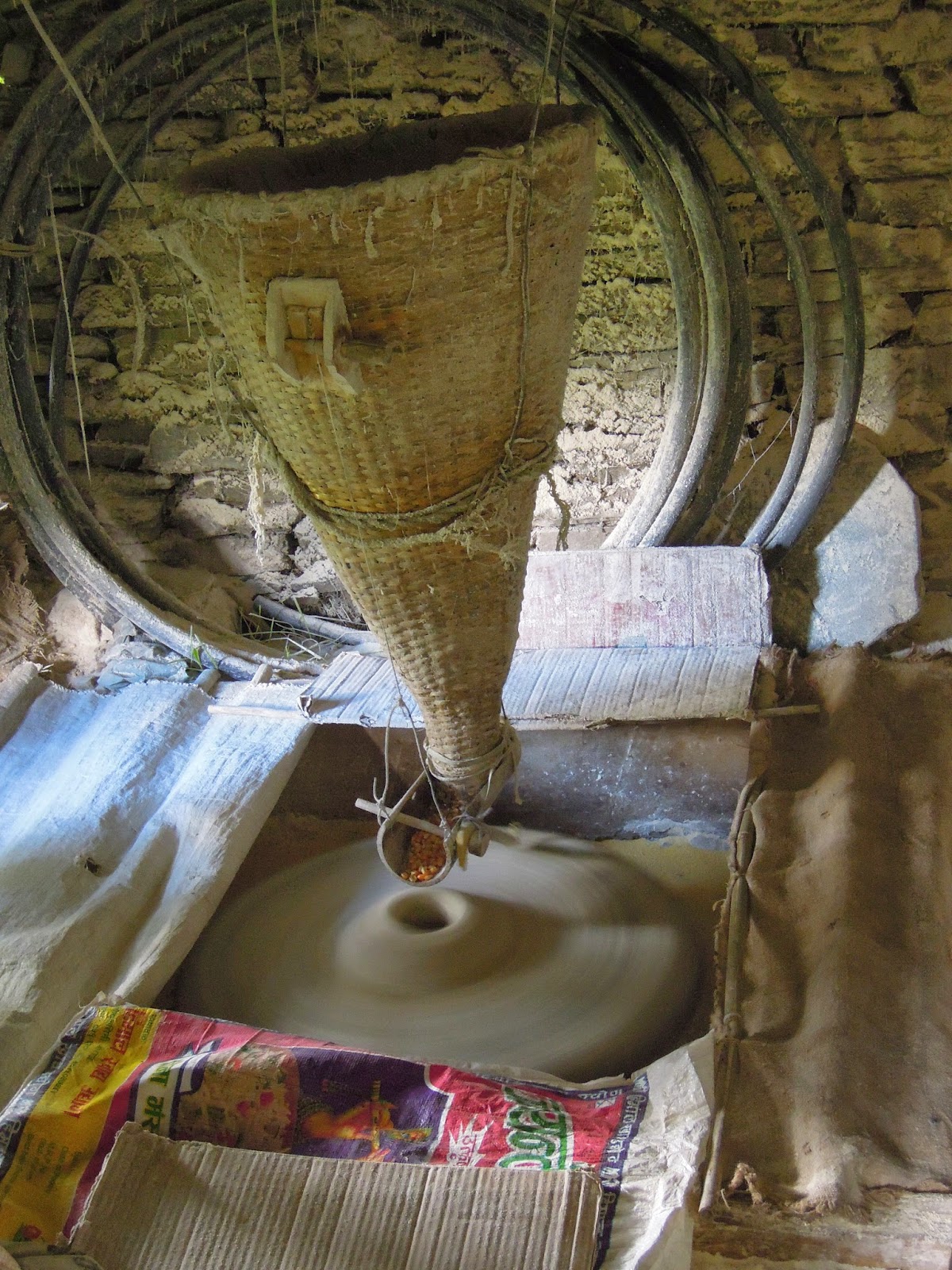
Accompanying rice and potatoes dishes, rotis (various bread types), noodles and momos are commonly found in Nepali cuisine's. Water being abundant and accessible, water mills provide the communities with rice, wheat, corn and buckwheat flour according to seasonal availability.


Water Mill


Grinding corn into flour

Humm, delicious makai (corn) and  
phapar roti (buckwheat bread)!


Saturday, November 22, 2014

I love honey!


Apis Cerana at work


Bees play an important role in any environment as plant pollinators. Within the Ghandruk area (2000-3000 m) the indigenous honeybees of the Himalayas are essential for the maintenance of the region's biodiversity and natural ecosystems. These hard working little friends occupy a key role in the pollination of mountain crops and consequently, contribute to food security and livelihoods of the Ghandruk rural households.

Don't get fooled by the Syrphid, this fly is not a bee!

Regardless their fame, many threats contribute to the dissemination of the domestic honeybees around the world. Although one might think that "mountain bees" would be spared from these potential threats, a similar increase in colony mortality is already observed and now monitored within the ACA region.

Among these threats we observe a slow but steady shift towards monoculture practices. Limiting agriculture to one crop type contributes to loss of floral diversity (and Biodiversity) and is often responsible to increased use of pesticides. In addition to this major threat, increasing access to remote areas by trekkers, sadly, too often goes hand in hand with environmental degradation.

Here in Ghandruk, beekeeping is an integral part of the history of the rural development of the communities by improving food productivity and providing honey, wax and other products for home use and sale. This is particularly true for landless individuals who rely on trading and monetary exchanges to obtain basic necessities.

Ghandruk communities have been in the past and are even today relying on both honey hunting of the Himalayan wild bee's colonies to obtain honey and using log hives to produce honey by domestic or wild bees.


There are four groups of bees in Nepal:
  • bumble bees
  • sting-less bees
  • solitary bees
  • honeybees

According to Bahadur Gurung & al. (2012), five species of HONEYBEES are found in the Himalayas:

Little honeybee (Apis florea)
Giant honeybee (Apis dorsata)
Himalyan cliff bee (Apis laboriosa)
Asian / Indigenous hive bee (Apis cerana)

The Little honeybee (Apis florea) can be found in hills and plains at altitudes up to 1,200 m. These bees build single small comb nests under small tree branches or bushes. A colony can produce 1 kg of honey per year.

Their big sister, the Giant honeybee (Apis dorsata) is also fund in hills and plains but at lower altitudes up to 1,000 m. They usually build single large comb nests on the top of tall trees, buildings, or water towers. These big sisters are highly defensive and performs mass attacks. They also produce considerably more honey per year (30-50 kg per colony).

Similar to his cousin Apis dorsata, the Himalayan cliff bee (Apis laboriosa) is darker and more defensive. Not only they build larger single comb nests but also produce considerable more honey per year with an average of 60 kg per colony and prefers nesting on large steep rocky cliff faces.

One of many comb nests found within Ghandruk

The honey produced by the Himalayan cliff bee is highly prized and in Nepal, honey hunting is a vital part of the Nepali culture. However, health of these bee's populations are threatened by human disturbances and resulting habitats degradation. 

Finally, while walking around Ghandruk, one can find tree logs hanging on the side of houses. When the sun shine and temperature rises, all these little workers get down to work. Apis cerana (Asian or indigenous hive bee) is the only bee that can be kept in these hand crafted log hives.
Log hive found on the neighbour's house wall

They differentiate themselves from their cousins by building multiple parallel combs (number depends on the colony size) and by establishing themselves in plains and hills from below 300 m up to 3,400 m.These bees can produce up to 20 kg of honey per hive per year and are resistant to diseases and mites, main culprit of the European honeybee populations dissemination worldwide.
In Ghandruk, the European honeybee (Apis mellifera) was introduced for commercial beekeeping as it builds multiple parallel combs and can be keep in movable frame hives.


Bahadur Gurung, Uma Partap, Nabin CID Shrestha, Harish K Sharma, Nurul Islam, Nar Bahadur Tamang, 2012. Beekeeping Training for Farmers in the Himalaya. Resource Manual for Trainers International Centre for Integrated Mountain Development, Katmandu. 190 p.

Sunday, November 16, 2014

Annapurna Sanctuary Trek

Don't miss the sign to the Annapurna Base Camp

So five motivated volunteers and myself decided to head to the Annapurna Base Camp (ABC: 4130 m) for a bit of exploration. We left Ghandruk Thursday (Oct. 23) after breakfast with the objective to reach the ABC and return by Sunday.

Five motivated volunteers, myself & the sunrise over the ABC

It took us 4h to reach Chhomrong (2170 m) from our Ghandruk Guest House (2100 m). After traversing the old Ghandruk, an endless stone staircase surrounded by rice and millet paddies took us first all the way down to the Kimrong Khola (river) where a suspension bridge allowed us to reach the opposite side.

Old Ghandruk

Suspension Bridge over the Kimrong Khola

Naturally, what goes down generally goes up again! We then climbed another staircase up to Kimrong (1800 m), Taulung (2180 m) and Chhomrong. After lunch, we made it to Bamboo (2310 m) in 3.5h. Once more, the trail drops down a set of stone steps to the Chhomrong Khola, and then climbs to Sinuwa and on through rhododendron forests although not in flowers at the time, to Kuldi (2470 m) and finally to Bamboo (2310 m) where we spent the night.

Beautiful scenery from Sinuwa looking at Ghandruk
 
Lucky we were to see some Hanuman Langur throughout the luxurious forest
Friday morning, we hiked from Bamboo (2310 m) to Deurali (3230 m) in 2 1/4h passing through Doban (2540 m) and Himalaya (2840 m).

Sure enough, no one ate meat....

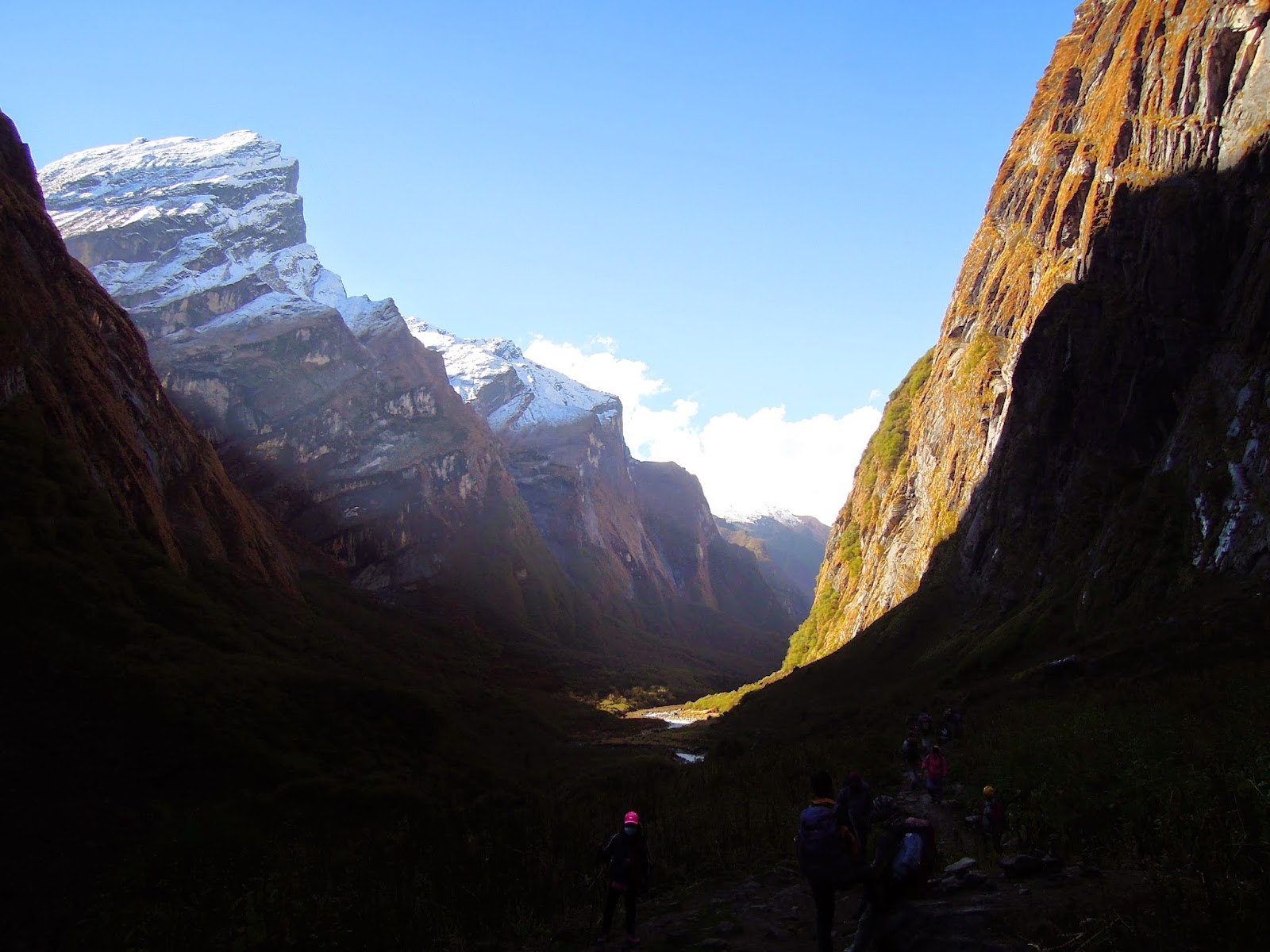
Although there were no sight of snow, we passed several avalanche chutes on the way. After a quick bite, and another hour of hiking we reached the Machhapuchhare Base Camp (3700 m) just before the clouds. This mountain is sacred and therefore it is not permitted to climb it.


Machhapuchhare Base Camp 3700 m

We set the alarm clock for 4 am on the following day in order to witness the sunrise illuminating the magnificent amphitheatre of rock and ice surrounding the South Annapurna Base Camp (ABC 4130 m). It took us about an hour to reach the moraine past the ABC.

Temperatures were low and the sight of snow made feel at home for a moment ;)
 
Approaching ABC before sunrise

Sunrise on the Annapurna Base Camp

Once the day took over the sunrise, we headed back to our MBC Hotel ate breakfast and started our descent to Ghandruk. We took 3h to reach Bamboo and 1h to reach Chhomrong where we spent the night. Sunday morning we hiked the last 3 1/4h to Ghandruk early enough to be on time for our 11h lunch at our Guest House.

 
This (minus the crowds), I like!

Species seen so far...

Our field work have not been really productive so far. This might be due to temperatures below seasonal normals and increased precipitations. 

Anyhow, let me introduce you to my new little friends...


Commonly found around 2000 m and widespread across Nepal, the Hill Jezebel (Delias Belladonna)


 The Indian Forest Skink


The Variegated Mountain Lizard


The Collared Back Headed Snake. Their eggs where found on the trail and hatched under the monitoring of our herpetologist... Cute little guys!


 Himalayan Mountain Keelback
And here a closeup view allowing to see his forked tongue and glottis


Our young Common Leopard, rescued after being abandoned by his mother. The animal was relocated in order to reassure the inhabitants and receive necessary care.


 One of ours Himalayan shoe eating cat... There are tree living around the Guest House, all the same color. These guys are really good hunters as they bring us dead shrews and rats every single day!


Rescaping one of the many shrews found in our pitfall traps!


 After much expectation, it is on our way to the Annapurna Base Camp that we finally encounter the Hanuman Langur!


Regardless the fact that 240 species of birds have been identified in Ghandruk, I only had the chance to
observed the following ones:
 
  • Black Eagle
  • Himalayan Vulture
  • Large Billed Crow, in great numbers throughout the crops
  • Blue Whistling Thrush
  • White-collared Blackbird
  • Himalayan Bulbul, who hangs around the house gracefully wearing a punk type headdress
  • Various Warbler species
  • Green-backed Tit, who keeps coming every day for the “all you can eat moths” on our dining room window!
  • Common Myna
  • Grey Buschchat

Sunday, November 2, 2014

Mountain Ecosystem Goods and Services

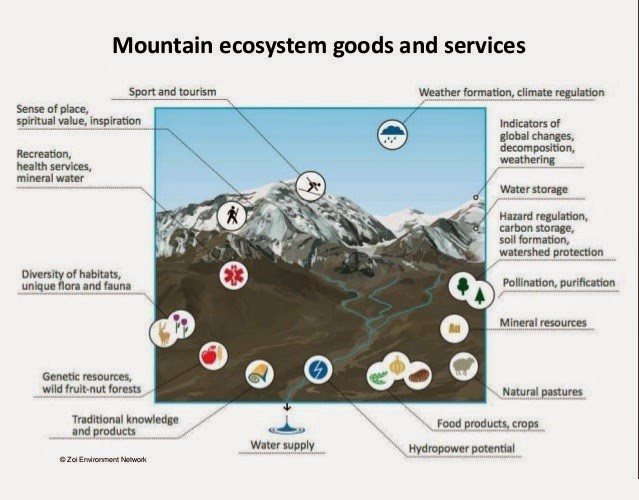
When one talks about Goods and Services, everyone understand. Although, when I speak about Ecosystem Goods and Services, a big question mark generally appears in my interlocutor’s face.
 
In short, the term ecosystem refers to the combined physical and biological components of an environment. These organisms form complex sets of relationships and function as a unit as they interact with their physical environment (WHO).
 
Ecosystem Goods and Services are the benefits people obtain from ecosystems, often for free. These include provisioning services such as food and water; regulating services such as flood, weather and disease control; cultural services (non-material benefits) such as spiritual, recreational, and cultural benefits; and supporting services such as nutrient cycling that maintain the conditions for life on Earth. 

These Goods and Services are essential for human well-being and survival. Therefore, when we impact our ecosystems, we consequently impact our well-being.
 
The Millinium Assessment provides a Conceptual Framework of how human well being and health is impacted by changes in ecosystems, at local, regional, and global scales.


The demand for ecosystem services is now so great that trade-offs among services have become the rule. A country can increase food supply by converting a forest to agriculture, for example, but in so doing it decreases the supply of services that may be of equal or greater importance, such as clean water, timber, ecotourism destinations, or flood regulation and drought control.
 
The problem posed by the growing demand for ecosystem services is compounded by increasingly serious degradation in the capability of ecosystems to provide these service. This is particularly true when dealing with mountain environments.
 
http://www.slideshare.net/CIFOR/mapping-vulnerability-and-resilience-for-ecosystembased- approaches-to-adaptation


This is also why I was really interested in learning more about the Nursery Project as Ghandruk is located in a mountain region. Mountain regions are characterized by sensitive ecosystems, enhanced occurrences of extreme weather events, and natural catastrophes such as land slides and floodings or such as the recent avalanche at the Thorung La pass.

View from our guest house 2100 m overlooking from left to right at: Annapurna South 7219 m, Annapurna I 8091 m, hidden behind the mountains Annapurna Base Camp 4130 m, Mardi Himal 5587 m behind the clouds and      Machhapuchre (Fish Tail) 6993m.

This project addresses tree obvious objectives directly linked to the management of difficult environment such as mountain and alpine ecosystems. The first objective being to ensure timber for construction, fuel for cooking and forge plants for buffalo and oxen. Insuring the availability of such plants and schrubs helps reducing soil erosion due to a combination of intense grazing and important precipitations during monsoon’s seasons. Finally, the third objective aims at maintaining and improving the Biodiversity through the growing of rare and endangered species according to IUCN red list.

Sadly, the greenhouse build for the purpose of maintaining Biodiversity through critically endangered tree and schrub species planting was destroyed during last monsoon's season (July & August 2014).
 
Seasonal needs for goods and services are directly linked to tourism

Ever wondered how Tea Houses and Hotels can provide food at such altitudes as the 4130 m of the ABC

Often regarded as hostile and economically nonviable regions, mountains have attracted major economic investments for tourism. We can simply look at the Canadian Rockies or the French Alps to predict the issues places like the Annapurna Conservation Area might be facing in the near-future. The projected amplitude and rate of climatic change in coming decades is likely to lead to significant perturbations of natural systems as well as the social and economic structure of mountain societies, particularly where these are marginal. 

Because in many instances mountains and uplands are regions of conflicting interests between economic development and environmental conservation, shifts in climatic patterns probably will exacerbate the potential for conflict. Sadly, this story seems to repeat itself over and over again around the world.
 
The daily life of Ghandruk communities is closely linked to seasonal cycles both in terms of agriculture and tourism industry which in turn, is under the influence of weather's whims.
 
As a major ecosystem representing the complex and interrelated ecology of our planet, mountain environments are essential to the survival of the global ecosystem. 

Mountain ecosystems are, however, rapidly changing. They are susceptible to accelerated soil erosion,landslides and rapid loss of habitat and genetic diversity. On the human side, there is widespread poverty among mountain inhabitants and loss of indigenous knowledge. As a result, most global mountain areas are experiencing environmental degradation. Hence, the proper management of mountain resources and socio-economic development of the people
deserves immediate action.
 
I certainly hope that the Annapurna Conservation Area Project (ACAP) will continue to work closely with the communities to reduce the degradation of this beautiful place.


With the support of ACAP, solar panels and small hydroelectric plants provide Ghandruk with energy

Wednesday, October 29, 2014

Traditions - part 2

Ghandruk is divided into sections within each a Misrom Bareh Temple can be fund.

Inside of the Temple

View from outside the Temple
The story says that one orphan was once upon a time adopted by gods. After living with them for a while, he returned to Earth to continue his life. Although, the gods advise him not to talk and/or get close to woman as he would looses all his powers. One day, he obviously did not resist the temptation and fell in love. They married and the man lost all his powers. 

This is why in each of these temples women are not allowed inside...

Gate to the Tea Garden

This Temple overlooks a beautiful Tea Garden which provide kalho ciyah (black tea) for locals and a beautiful scenery for hikers....

Tea plantation overlooking old Ghandruk

Indigenous flowers